


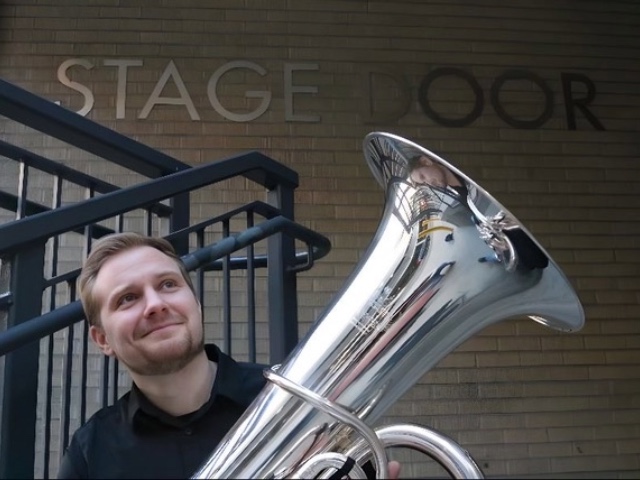
For Patrick Young, much of a musician’s work happens out of sight—long hours in practice rooms, late nights refining technique and countless moments of perseverance. His quiet dedication has earned a national spotlight.
Young, director of bands and assistant professor of tuba and euphonium in Samford University’s School of the Arts, has been named a national finalist in the professional division of The American Prize in Instrumental Performance—one of the nation’s most respected honors recognizing artistic excellence.
“Being named a national finalist is incredibly meaningful to me,” Young said. “On a personal level, it feels like a validating reflection of many years of dedication, sacrifice and belief in the value of music-making at the highest level.”
When he learned the news, Young immediately shared the moment with those who helped shape his journey. “I was very excited,” he said. “I reached out to many former teachers and mentors to let them know the great news.”
That sense of gratitude reflects a career grounded in performance and purpose. As an active performer, Young brings a holistic perspective to his work with students—one shaped by experience and sustained by connection.
“Music is ultimately about connection, communication and serving something larger than ourselves,” he said. “Balancing both performing and teaching allows me to remain an active musician while bringing real-world experience directly into the classroom and rehearsal hall.”
That dual role benefits students in tangible ways. By continuing to perform, record and collaborate professionally, Young models a lifelong commitment to growth. “It reminds them that learning never truly stops and that a career in music can take many different forms,” he said.
At the same time, he credits his students as a constant source of inspiration.
“My students inspire my artistic growth every day through their energy, humor and passion for music,” Young said. “Watching them overcome challenges, gain confidence and achieve things they once thought were impossible motivates me to continue growing as both a musician and educator.”
The national recognition also reflects the broader culture of excellence within Samford’s School of the Arts. Faculty members actively engage in their disciplines, creating an environment where teaching and professional practice go hand in hand.
“One of the greatest strengths of Samford’s music faculty is that we can truly ‘talk the talk and walk the walk,’” Young said. “Our professors are not only passionate educators, but also active professionals who continue to perform, create and contribute to their fields at a high level.”
The honor is both personal and collective. He points to mentors, colleagues, students and the wider Samford community as essential to reaching this milestone.
“This recognition may have my name attached to it, but it reflects the investment, encouragement and belief that so many people have poured into my life and career,” he said. “I’m truly grateful.”
As he continues to perform and teach, Young hopes this moment serves as a reminder—to his students and to the broader campus community—of what is possible through dedication, discipline and a commitment to excellence.
