


Every architecture studio begins with a premise.
A site. A set of constraints. A challenge meant to sharpen how students observe, analyze and respond to place.
For junior architecture students enrolled in Architecture Design Studio IV, instructed by Marshall Anderson and department chair Ryan Misner, that premise took shape along 18th Street at the northern edge of downtown Homewood—not as a development proposal or planning exercise, but as a hypothetical academic assignment rooted in a real and recognizable context.
The site sits at a moment of transition: where the energy of downtown begins to shift, where movement patterns change and where neighborhoods meet. That made it an ideal testing ground for questions at the core of architectural education—how buildings shape streets, how people move through public space and how design can support connection.
The goal was exploration, not outcomes. Students were asked to think critically about mixed‑use development, walkability and civic space, but remain attentive to the site’s relationship to downtown Homewood and the adjacent historic Rosedale neighborhood.
As the spring semester unfolded, the ideas being developed began to extend quietly beyond the studio—not through advocacy or proposal, but through listening and exchange.
The assignment carried particular weight for Caroline Rankin and Kennedy Phillips because the site was already familiar.
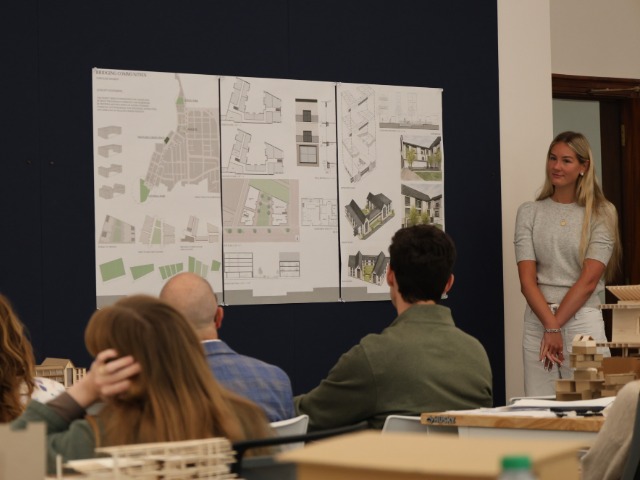 “I was really excited about the location,” Phillips said. “I’ve spent a lot of time in downtown Homewood, so it felt meaningful to work on a place I know.”
Rankin shared a similar connection. “I drive past it every day,” she said. “Once you start studying it closely, you realize how much responsibility that part of downtown carries.”
Although each student designed a separate site, the two worked as partners throughout the project, collaborating closely while allowing each design to stand on its own. Their partnership reinforced a shared focus on continuity—not just between buildings, but across the street and into surrounding neighborhoods.
“Our ideas evolved because we were constantly talking them through,” Phillips said. “That pushed both of us beyond our first instincts.”
Rankin’s design centered on civic space, using green areas to encourage gathering and interaction.
“That part of town doesn’t have much public green space,” she said. “Creating a destination people actually want to walk to can change how the area is experienced.”
Phillips focused on circulation and street continuity, studying how storefront placement and pedestrian flow could strengthen the sense of 18th Street as a connected corridor rather than a series of fragments.
“I noticed a disconnect in foot traffic,” she said. “I wanted the street to feel seamless—like one continuous experience.”
Throughout the process, the proximity of Rosedale influenced nearly every design decision. Both students described the challenge of balancing respect for a historic neighborhood with the realities of downtown growth.
“Designing for a place everyone knows makes you more careful,” Rankin said. “You want the project to contribute without overpowering what’s already there.”
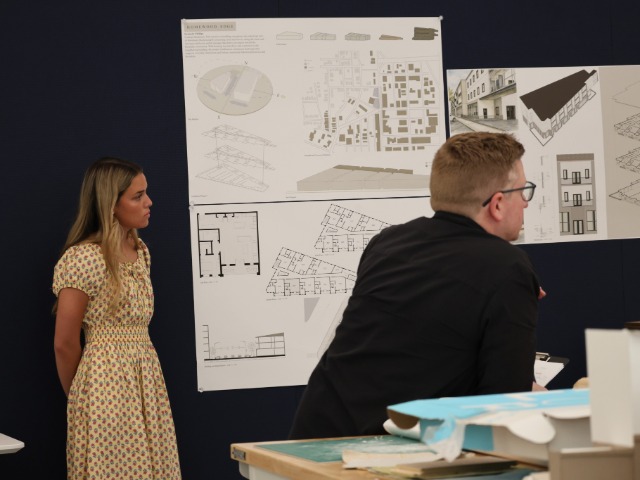 Phillips said studying Rosedale more closely changed how she approached the work. “I had to move past my assumptions and really learn the context,” she said. “That made the design more intentional.”
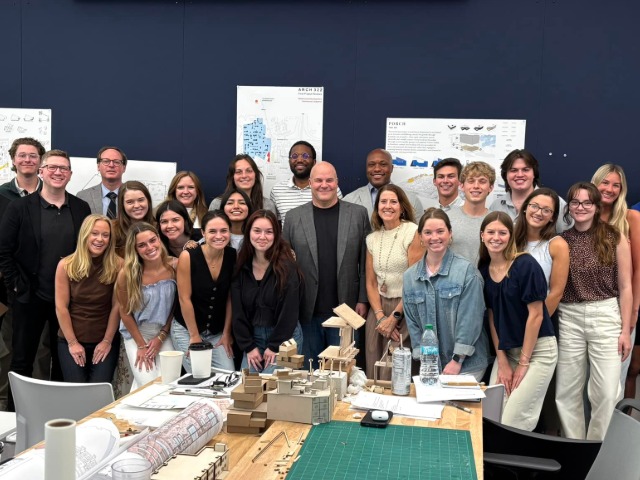
Late in the semester, the students shared their work beyond campus. Some of Homewood’s elected leaders and local architects were invited to listen as they presented their ideas, which reframed the assignment without changing its intent.
Homewood Mayor Jennifer Andress said the presentations offered genuine insight.
“I was impressed with the thoughtfulness of the students,” Andress said. “I learned a lot about an area I thought I had studied extensively.”
She noted that several projects identified a drop in walkability north of 28th Avenue, a theme that echoed ongoing city conversations.
“We have done a lot of work in the north 18th Street section, so it is much improved, but I learned we have more work to do,” she said.
Equally important was the students’ attention to Rosedale’s history and character.
“It’s vitally important to honor and preserve historic Rosedale, one of Homewood’s original neighborhoods at our founding 100 years ago,” Andress said. “This neighborhood has been forever altered with the Red Mountain Expressway and commercial encroachment. It was wonderful to see the students’ projects embrace the neighborhood behind them. Down-zoning to mixed use softens the purely commercial zoning that currently exists.”
For Rankin and Phillips, the experience reinforced the complexity of designing for real places.
“Getting feedback from city leaders and architects made everything feel more connected,” Rankin said.
Phillips said comments about how the two projects worked together changed her perspective. “It reminded me that architecture is never isolated,” she said. “Every decision affects what’s around it.”
For Samford, the exchange reflects a broader commitment to being a good neighbor, using academic work as a way to engage thoughtfully with the community it calls home.
“This entire semester has been really rewarding. From an architectural standpoint, it allowed our students to wrestle with some complex and difficult design parameters, and they did a great job with thatchallenge,” Misner said. “It was also rewarding to have Homewood representatives involved in the process and continue to foster our relationship and our ability to be a resource to the local community.”
“Absolutely, we want that relationship to keep growing,” Andress said. “We’re honored to have Samford in Homewood.”
What stayed with the students wasn’t a single solution or design move—it was the process—slowing down, studying a familiar place more closely and understanding how many layers shape it.
Designing for the edge of downtown Homewood meant paying attention to transition and connection rather than conclusion.
For Rankin and Phillips, the assignment reinforced a lesson that will follow them beyond the studio: good design begins with careful looking and with respect for the places and communities already there.
